
One program for structural design, ASCE 41 evaluation and FEMA P-58 loss assessment.
Design new steel and concrete buildings to AISC 360 and ACI 318, with loads and seismic criteria from ASCE 7. Evaluate existing ones to ASCE 41-17 and 41-23. Apply FEMA P-58 to either for probable repair cost and repair time — with every demand, strength, acceptance criterion and calculation behind a result open to inspection.
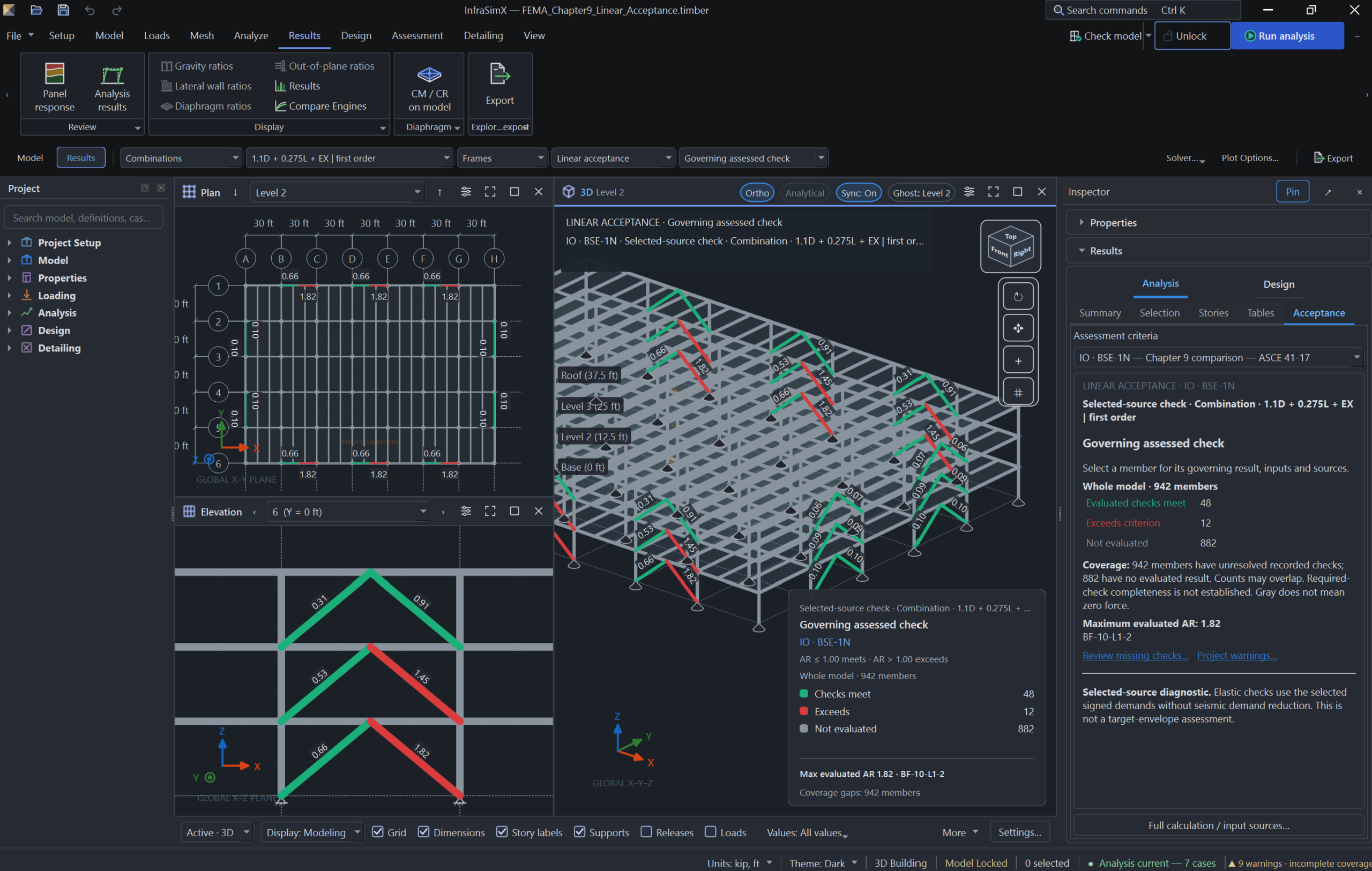
Linear acceptance across the model: green meets the criterion, red exceeds it. Open the full-size image.
One program. Whether the building is new or already standing.
The structure
Geometry, sections and materials, built once. Each route below then adds what that standard requires — it is not the same model three times.
building
Size and check every beam, column and connection against the code, with the calculation behind each result open to inspection.
building
Whether it reaches the performance level you are aiming for in the earthquake — stays usable, stays safe, or only just avoids collapse — and which component falls short first.
one
The repair bill and how long the building is out of use — for a new design, or for the existing building you are evaluating.
Three target conditions after the earthquake.
Immediate Occupancy
Strength and stiffness essentially retained. The building can be reoccupied.
Life Safety
Significant damage, with margin against collapse retained. Repair may be uneconomic.
Collapse Prevention
On the verge of collapse, with little residual strength or stiffness left.
All four procedures, each with its own acceptance test.
ASCE 41 classifies every action by how its component fails, then applies the criterion that matches the procedure you ran. InfraSimX supports all four — linear and nonlinear, static and dynamic — and applies the right test in each case.
Performance objective
Pair a target structural performance level with a seismic hazard level. Risk Category sets the pairing.
Evaluation tier
Tier 1 screening, Tier 2 deficiency-based, or Tier 3 systematic evaluation and retrofit.
Data collection
As-built drawings, testing and condition assessment set the knowledge factor κ.
Analysis procedure
Linear or nonlinear, static or dynamic — LSP, LDP, NSP or NDP.
Acceptance
Each action is classified, then checked against the criterion for its class and for the procedure used.
A force check. The m-factor credits the ductility available at the target performance level, and capacity is the expected strength.
No ductility credit. Capacity is the lower-bound strength, and the demand is reduced only by the force-delivery factors.
No m-factor. The deformation computed by the pushover or response-history analysis is compared directly against the acceptance limit for the target level.
The same inequality, but the demand is the largest force the nonlinear response can deliver, or the value from a capacity-based limit-state analysis.
Understand performance beyond the elastic response.
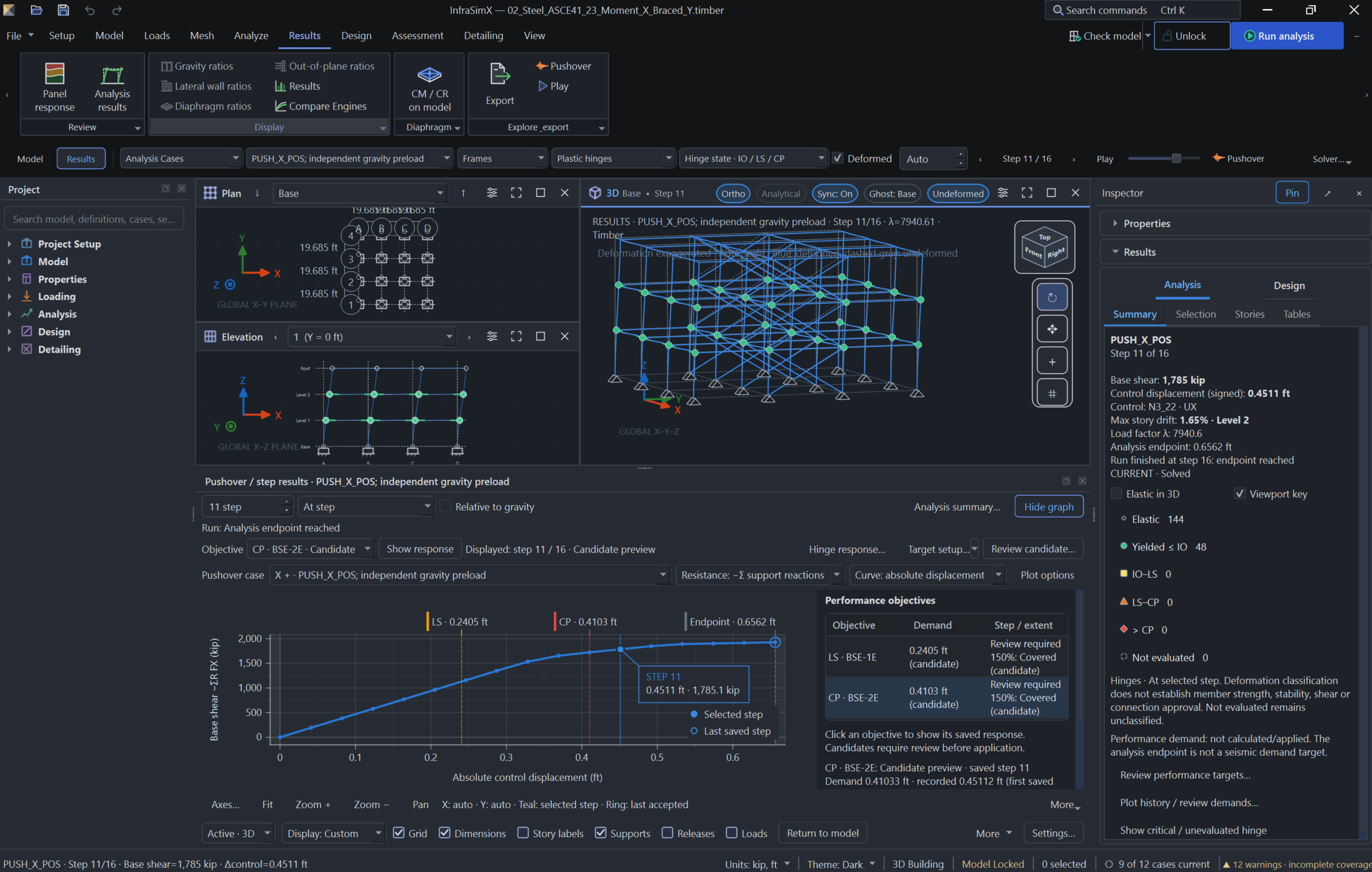
Pushover response with LS and CP demand markers and component deformation states.
See the response at your performance objective.
Select a performance objective and inspect the corresponding saved structural response. Explore deformations and plastic-hinge states across synchronized views, with the demand, recorded displacement and assessment gaps clearly identified.
Calculate seismic demand. Review the calculation.
Calculate hazard-based target displacements from the pushover response. Review the capacity idealization, effective stiffness and yield strength, with the equations, inputs and assumptions available for inspection before applying the target.
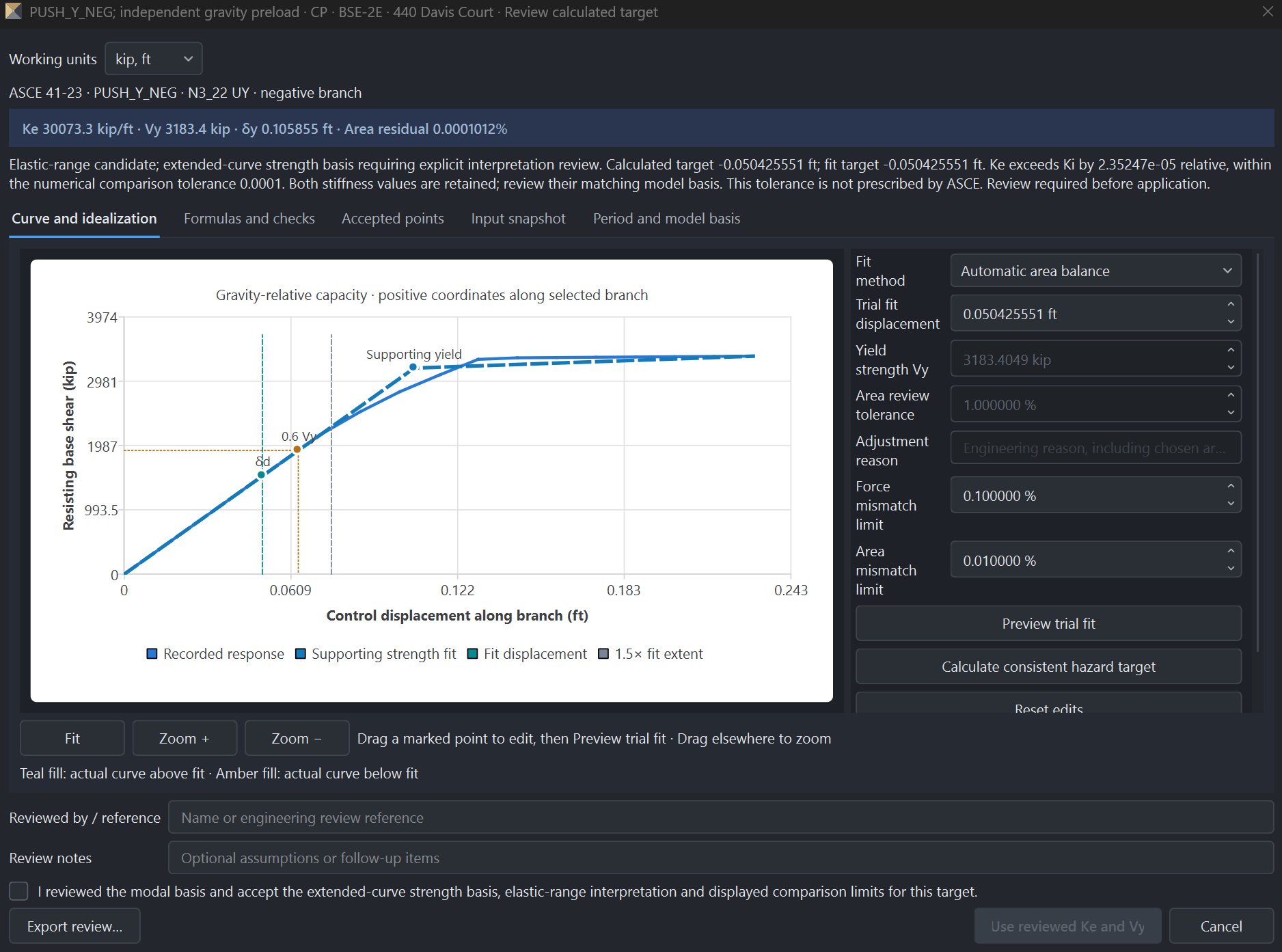
Capacity idealization and target-displacement calculation in one review workspace.
What it costs, not only whether it passes.
ASCE 41 answers whether the structure meets a performance level. FEMA P-58 answers what the earthquake does to the owner — repair cost, repair time, and the risk of the building being tagged unsafe. InfraSimX runs both from the same model.
Shaking
Site hazard, or a scenario earthquake you choose.
Demand on the building
Story drift, floor acceleration and residual drift, taken from the analysis you have already run.
Component by component
Fragility functions turn response into damage states for each component, structural and nonstructural.
Cost and time
Consequence functions turn damage into repair cost and repair time, carried through Monte Carlo so the answer is a distribution, not a single number.
As a fraction of replacement cost, reported with its spread rather than a single mean.
To reoccupancy and to full restoration — the number an owner actually plans around.
Residual drift that would place a red tag on the building, or push it to demolition.
What the program does.
The geometry carries over
A design model is not an assessment model: ASCE 41 needs expected strengths, a knowledge factor and hinge backbones, and FEMA P-58 needs drifts, accelerations and a component inventory. The structure you built carries into each — you add what the standard asks for, instead of starting again in another tool.
Plastic hinges from the code
Hinge backbones and acceptance criteria generated automatically from the standard’s tables for the section, material and action — not entered by hand.
The action that governs
At each target level, which action controls the result and the margin by which it passes or fails — not just a pass or fail for the building.
Envelope across cases
Demands enveloped across load cases and combinations, so the value you see is the one that governs.
Compare without exporting
Put cases, performance levels and procedures side by side in one workspace, instead of reconciling spreadsheets after the fact.
Drawings and reports
Connection drawings, detail sheets and calculation reports generated from the checks you have run.
ASCE 41-23
ASCE 7-22
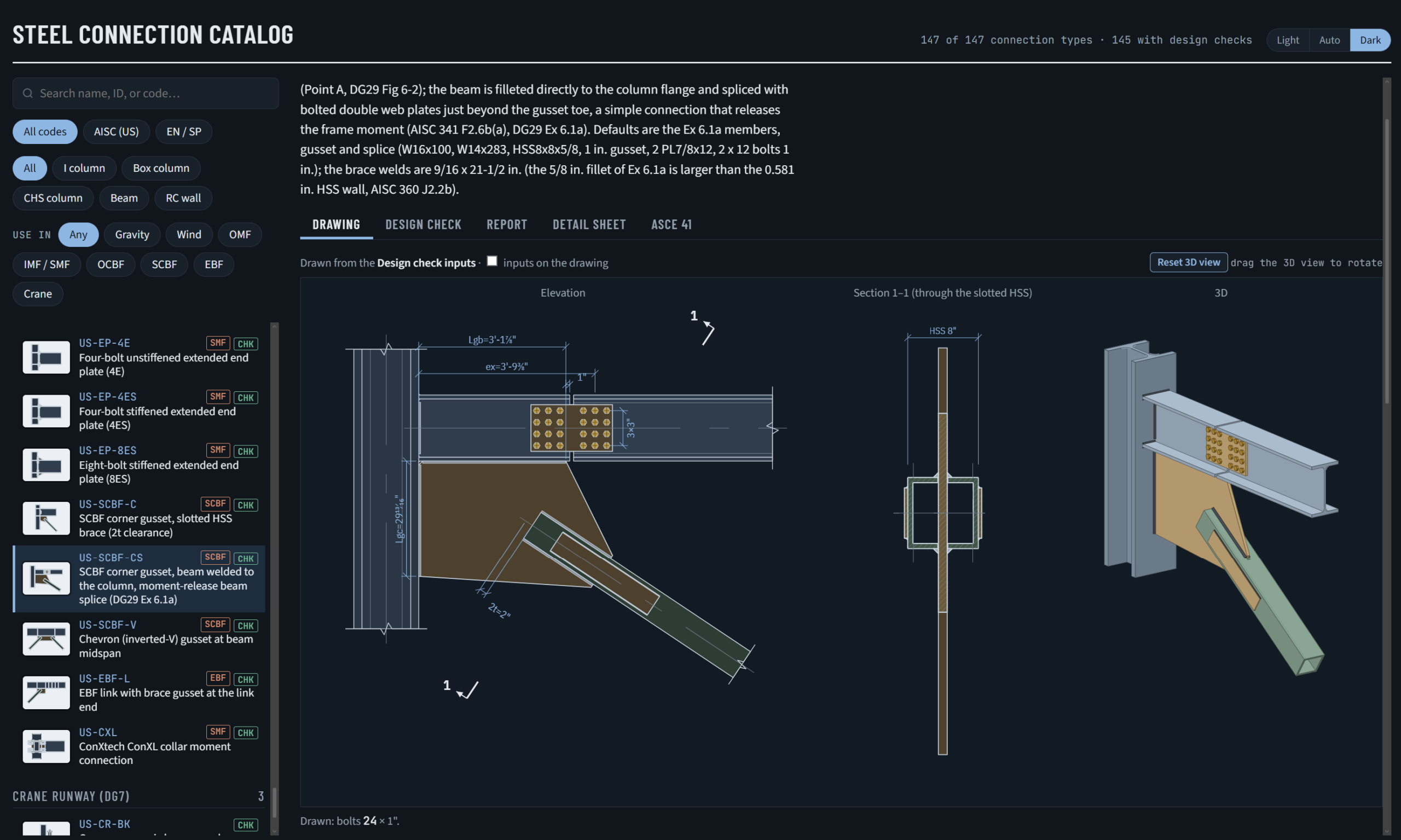
SCBF corner gusset, AISC Design Guide 29: elevation, section and 3D detail. Open the full-size image.
Inspect the connection behind the load path.
Explore connection geometry, review supported strength checks, and inspect the governing calculation.
147 connection types, 145 with design checks, each with its drawing, detail sheet and calculation report.
Benchmark comparisons, with the reference values stated.
Each comparison states the source example and its reference, the modelled assumptions and software version, the reference values beside ours, and what it did not cover. These are benchmark comparisons, not a claim of complete validation.
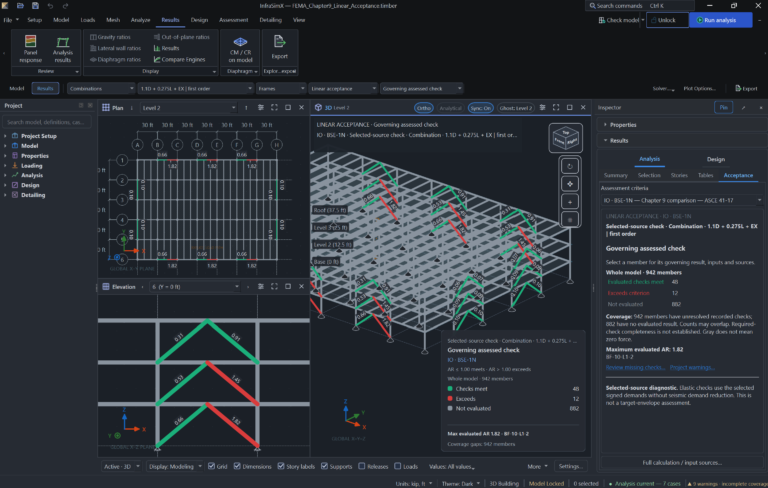
Chapter 9 benchmark, linear acceptance
A published Chapter 9 example assessed to ASCE 41-17 acceptance criteria, with our values set beside the reference.
Assessment and design, carried out by our engineers.
Alongside the software, InfraSimX provides structural, geotechnical and seismic engineering for buildings and infrastructure. The work runs from numerical simulation and risk assessment through to design support and fabrication-ready shop drawings.
- Structural analysis and design
- Seismic and performance assessment
- Geotechnical and soil–structure interaction
- Numerical simulation and risk
- Design support and shop drawings
See the assessment run on a structure you know.
Walk through your own structure with us, or start from one of the benchmark comparisons.